
Three estimates arrive for the same silver maple and one of the trucks has a letter grade decaled on the door. Most homeowners in Springfield read that as a general endorsement and move on. It is worth slightly more than that and considerably less than it looks, and the difference matters when you are deciding who gets to run a chainsaw twenty feet above your roof. The rating is a summary of how a company handles being complained about. That is a narrow thing to measure, but it happens to be a revealing one.
What the letter grade is actually scoring
The grade is not a quality score for the work. Nobody inspects a pruning cut to produce it. It is built from a company’s record of disputes: how many complaints have been filed, how serious they were, whether the business answered them, how fast, and whether the customer walked away satisfied. Time in business factors in, as does transparency about who owns the company and how to reach them.
So a high grade tells you something specific and useful — when this company has had a problem with a customer, it engaged and resolved it rather than going silent. For tree work that is not a trivial signal. The disputes in this trade tend to be about damage: ruts across a lawn, a dropped limb through a fence, a stump ground shallower than promised. What you want to know is what happens after something goes wrong, because on a big removal something occasionally does.
Accreditation is a separate thing from the grade
These two get conflated constantly. A company can carry a high grade without being accredited, and accreditation is the part that involves an application, a review, and an ongoing fee. Accredited businesses commit to a published set of standards — honest advertising, transparent pricing, responsiveness to disputes — and can lose the status for failing them.
The practical value is in the date. A business accredited for fifteen years has stayed inside those commitments across fifteen years of jobs, storms, hires and busy seasons. That is a harder thing to fake than a batch of reviews.
The complaint record is the part worth reading
Skip the badge and open the actual profile. You want the complaint history, the responses, and the dates. A company with zero complaints and forty years of operation is either very small or very lucky; a company with a handful, each answered and closed, is usually the more honest picture of a working outfit.
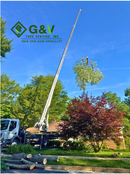
As a worked example, G&V Tree Service Inc’s accredited BBB profile shows an A+ rating alongside accreditation dating to September 2008 — so the underlying record covers well over a decade and a half of continuous operation in this area, not a recently minted listing. That combination, a long accreditation date plus a maintained grade, is the shape worth looking for on any company you are considering.
What it does not tell you
It says nothing about arboriculture. A company can hold an excellent grade and still top trees, cut into branch collars, or send an unqualified climber up a dying oak. The rating measures business conduct, not horticultural competence, and the two are genuinely independent.
It also says nothing about whether the crew is insured today. Coverage lapses quietly and no directory tracks it in real time. That is a certificate you request from the insurer directly, for the dates your job is scheduled, every time — regardless of what any profile says.
And it cannot tell you whether the price is fair. A well-regarded company can still quote high, and a company with no profile at all can do excellent work for less. The rating narrows your risk of being ignored after a problem. It does not replace getting three quotes.
Where it fits among the other checks
Treat it as one input of four or five. Confirm current general liability and workers’ compensation from the insurer. Ask whether an ISA Certified Arborist is assessing the tree, not just whoever answers the phone. Get the scope in writing — which limbs, what depth on the stump, where the chips go. Walk the property with the estimator.
Then use the dispute record as the tiebreaker it is good at being. When two companies quote within a few hundred dollars of each other and both seem competent, the one with a documented history of answering its complaints is the safer bet. Not because the grade is magic, but because it is evidence about the only thing you cannot test in advance: what this company is like on its worst day rather than its best.
One practical note for Springfield and the surrounding Fairfax County neighborhoods — a lot of the work here happens on tight interior lots with mature canopy and shared driveways, where the damage risk is to a neighbor’s property as much as your own. That raises the value of knowing how a company resolves disputes, because the person filing one might not be you.
Where to find us
The map traces the drive from the Laurel Hill area of Fairfax County to G&V Tree Service, 6434 Brandon Ave, Springfield, VA.
G&V Tree Service Inc · 6434 Brandon Ave, Suite 204, Springfield, VA 22150 · (703) 569-2570